Sam.
Sa.
Let's talk science. Talk about science.
Good afternoon and welcome to NASA's Goddard Space Flight
Center. We are live today with NASA experts who are excited to
share the latest images we have of the interstellar comet 3I ATLAS.
3I means third interstellar and ATLAS refers to
the NASA funded ATLAS Survey telescope which made the discovery.
We are joined today by Amit Shatriya, NASA's associate administrator,
Nikki Fox, associate administrator for NASA's Science Mission
Directorate, Sean Domagal Goldman, Director for the Astrophysics
Division, and Tom Statler, Lead Scientist for Solar System
Small Bodies in the Planetary Science Division.
We'll be taking questions from the media on the phone bridge and through social media.
But before we get started, let's learn more about this fascinating
comet and share some images. Amit, kick us off. Hi everyone.
America leads the way in space exploration. As Courtney noted. A NASA
funded telescope, the ATLAS Survey telescope in Chile, first reported observations
of the Comet on July 1, 2025 to the minor Planet Center.
And NASA has been tracking and studying Comet 3I Atlas ever since.
We're here today to give you the latest of what we know about Comet 3i
Atlas and what we still want to know. But first, what is a comet?
It's a small natural solid body that is a combination of rocky and icy material
that evaporates as it gets warm, as it warms when it's close to a star
like the sun. But to start with, I'd like to address the rumors right
at the beginning. I think it's important that we talk about that this object is
a comet. It looks and behaves like a comet and has and all evidence points
to it being a comet. But this one came from outside the solar system,
which makes it fascinating, exciting and scientifically very important.
This is only the third interstellar object like this that humanity has ever found.
A little bit more about the rumors. I think it's very important and I'm
actually very excited that a lot of the world was speculating about the comet
while NASA was in a period where we couldn't speak about it due to the
recent government shutdown. I think what I took away from
that whole experience and watching that as we were working during the shutdown was
just how interested and how excited
people were about the possibility of what this comet could be. There was a lot
of speculation about what it could be. But what I think is really awesome is
that folks are interested in this incredible finding that we observed and that
we have that came from the heavens and what that means, what it could mean
about how magical the universe could be. It expanded people's brains
to think about how magical the universe could be. And I'll tell you, here at
NASA, we think that every day. And so it's really great that you
were able to join us. While we were not able to comment because of the
shutdown constraints about what that comment is, because we think the universe
is a magical place and we spend your treasure and we spend all of our
time trying to make sure that we explore that and share with you as much
as we can. In fact, we want very much to find signs
of life in the universe. In fact, just a few months ago, we were with
you and we talked about what we think might be the signal
from ancient life on the surface of Mars, from our amazing machines that have been
roving the planet for 30 years to look for those things.
That is something that's really important for us to
learn about and discover. It could be an amazing discovery if and when we can
confirm that. But 3I Atlas is a comet.
So my colleagues from the Science Mission Directorate will go through the images in detail.
But just to give you a peek, here's one of the images from the closest
physical instrument we had to the Comet, from the HiRISE instrument on our Mars Reconnaissance
Orbiter taken on October 2 as the comet sailed by at a distance of 19
million miles. From the instrument, you can see that Comet IIIRatlas
looks like a fuzzy white ball. That ball is a cloud of dust and ice
called the coma, which is shed by the comet as it continues its trajectory
towards the sun. I'll leave it to my esteemed colleagues to share further details.
And I'd like to introduce you to the head of NASA science, Nikki Fox.
Thank you so much. It is such a rare opportunity for
us to be able to observe this interstellar comet. And NASA science has
been given this, this really, really exciting opportunity to do it. And literally
from the moment of its discovery, just like Amit said, comets are
tiny cosmic snowballs. And by studying them, we can learn about the environment from
basically where they formed, where they came from. This one
came from a different environment from our own. And so we're already starting to see
some really interesting differences to comets from our own Solar System.
3i Atlas, as you heard, is the third known interstellar
object to pass through our solar system, the first one being identified in
2017. While these types of interstellar objects
have long been predicted, we are just beginning to be able to find them
thanks to the newest technologies with our network of Earth based
telescopes, which are designed to Find small, fast moving objects
in space. The NASA funded Atlas Survey Telescope, which made
the discovery, is part of NASA's Planetary Defense Network.
Our telescopes are always watching the skies to keep us
safe. And in doing so, they occasionally make major scientifically
interesting discoveries just like this one. Right away, of course,
NASA's Planetary Defense Coordination Office established, they studied it,
and they established that three Eye Atlas is not a danger
to Earth. In fact, it's at least twice, twice as
far away as the distance between the Earth and our Sun.
On October 30, the comet itself reached the closest
it will ever be to the sun when it crossed just inside Mars orbit.
Which is why the image that Amit just showed, he noted it was
the closest instrument physically to the comet because the comet was right
inside the orbit of Mars. Earth was on the opposite side
of the sun, which is about as far away as our planet can possibly
be from Mars. It's been clear from the moment of discovery
that the comet was going to pass on the opposite side of the sun from
where the Earth is. However, it was also clear that its positioning
behind the sun was going to make observations from Earth very, very difficult.
And that is why we are so happy to have our incredible fleet of NASA
science craft all across the solar system. And, boy, were they ready
for this event. NASA's Science Assets on board our
missions have provided the United States the unique capability to observe three
Eye Atlas almost the entire time it passes through our celestial neighborhood.
Everything NASA science does is interconnected, and nearly
20 mission teams have been working together to
really rise to this challenge. 20 mission teams, by the way, and counting.
Everything we're learning about the comet is possible because of the
distribution of all of the different instruments on our spacecraft with different
capabilities. And I'll note that for some of them, we've even
pushed our scientific instruments beyond their normal capabilities,
beyond the things that they were designed to achieve, to allow us to
capture this amazing glimpse at this interstellar
traveler. In other words, we can study this comet so well because
we have many different assets in different locations,
observing things in different wavelengths in different ways
with different instruments, each set of observations providing a different lens
for understanding objects in the sky. So NASA's science
team has kept watch on 3i Atlas for nearly its entire journey through
the solar system for the first time ever. So I'll just quickly go through
the timeline of which NASA spacecraft have observed the comet thus far,
and we're still going. There will be more opportunities to observe
this comet as it continues its journey through the solar system,
passing the orbit of Jupiter in spring
of 2026. So the NASA assets that are gathering
observations of 3I Atlas include Hubble, the James Webb
Space Telescope, TESS, Swift,
SphereX, Perseverance, Mars Rover,
Mars Reconnaissance Orbiter, Maven, Europa Clipper,
Lucy, Psyche, personal favorite, Parker Solar
Probe, punch stereo, and ESA, NASA's SOHO mission.
And I'll note that Parker Solar Probe's data were just downloaded yesterday. And indeed we
did catch several glimpses of this amazing comet. The scientific community
is hard at work analyzing these images and
everyone, as always, is welcome to take a look at
NASA. We embrace open science. We make all of our data available to the
public 24, 7. And we invite, in fact, we really want you
to tell us what you're observing and what you think about
what we're looking at. We're still learning, even about what questions
we still need to ask. And this of course, is the scientific process
in action. All the data go to a public archive.
We get those images as soon as we're able to from all of our
eyes in space. As always, I am excited to see what
new things we learn about our friendly solar system visitor in the days and
in fact, the years to come. So now I'm going to pass over to Sean.
He's going to tell you about what our astrophysics missions have
seen. They of course, were some of the first things to look at the comet.
And images from several of them have been available since
the beginning of the summer. So I'm going to ask you to set the stage
for us, tell us what we've already seen before we hand over to Tom
to tell us all the new stuff. Take it away, Sean. Thanks Nikki. Happy to
to give you some background. NASA's astrophysics missions,
like all our missions, they are designed to do things that
would otherwise be impossible. In this case, our nation's space
telescopes stare deeper and more sharply into the universe than any other
observatories in the world. And that means we're often the first to follow up and
study near Earth objects or comets like 3i Atlas after
they're initially detected, that same powerful gaze that lets us, these telescopes,
see distant galaxies, those little red dots you might hear about.
They also allow us to observe details about objects like
3i Atlas a little bit sooner. And the earlier we learn
about these objects, the earlier we can share this information with the world,
including the science community and our partners across the planet that
often have ground based assets or other space based assets so that they can conduct
additional observations with their telescopes. In this
case, our astrophysics Missions came together to take advantage of this rare
opportunity to study this comet that came to us from outside the solar
system. From our flagship space telescopes to smaller missions like Tess
and Swift, they all have, as Nikki said, different complementary capabilities.
They don't just do things that would otherwise be impossible. They do things that
even our other great telescopes can't do. So every time we add to the fleet,
we add additional capabilities that expand the realm of the possible. In this case,
it let us refine the orbit of this structure early on, determine what
its structure is and what its composition is, what it is made of. It's a
beautiful illustration of why we have not just one space telescope, but a fleet of
them. Because every one member of that fleet specializes in a different kind of
information, contributing a different piece of the puzzle to the total understanding
we have from the fleet as a whole. So, for example,
old reliable NASA's Hubble Space Telescope celebrated
its 35th birthday earlier this year. And not too long after that,
in July, it looked at 3i Atlas not long after
we discovered it from the ground. At this point, 3i Atlas was about
277 million miles from Earth. And what
Hubble's images revealed was a few things. First, a teardrop shaped coma
of dust coming off that solid icy nucleus of
the comet itself. From these data, astronomers were able to
more accurately narrow a few things. Importantly, the size
of the nucleus. We now know it's between at that point. Actually,
we knew it was between 1400ft in diameter, up to as large as
3 1/2 miles in diameter. And Hubble also
saw that the comet was losing dust and not just losing it, but losing it
at a rate consistent with other previous sun bound comets that originated
from within our solar system, consistent with the physics that we figured out from watching
those objects. Now, the last thing Hubble did is it gave us
a better understanding of the orbit of this object, tell us not
just where it was, but where it was heading. So we could point other observatories
at it, such as the James Webb Space Telescope. We added this to our fleet
early in this decade. We didn't have it when the last two interstellar comets came
around. And what James Webb did and its companion Spherex, which we only launched
at the beginning of this year, is it added infrared observations.
The power of infrared observations is these are colors
we can't see. They're redder than what our eyes can detect. And infrared
light is particularly good at helping us understand the composition of objects. We can see
little molecular fingerprints from the things that the Objects are made of.
So with these infrared observations with James Webb and Spherex,
we detected an abundance of carbon dioxide gas in the comet's coma and
in the bright cloud of gas and dust surrounding that comet as it approaches the
sun. Those molecular fingerprints I mentioned, those are the little, like science wiggles
you might see in the top right of these images. We now know from seeing
those science wiggles, those fingerprints of those molecules, that the comet has a nucleus
rich in carbon dioxide, as well as the presence
of water ice. Now, the ratio, like we can not just say that these
things are there. We can also say, what's the ratio of carbon dioxide to water?
And we now know that. We know it's larger than what we
usually see in solar system objects, but there's a lot
of natural explanations for that. For one, the carbon dioxide is
going to kind of bake off that comet earlier on when it's far away.
But there's other well understood processes that could also explain it.
I'll just put this in context. There are every time we look beyond
our solar system and we look at the ratios of carbon dioxide to
water, we see, whether it's a star or a planet,
different ratios than we see in the solar system. And that's true for this comet
as well. So it could mean, this is the last theory
of why those ratios could be different, that these ices could have been exposed to
higher levels of radiation than comets in our own system. Or as I said before,
could be that the comet just formed from a region where carbon dioxide ice
was particularly abundant and different from our solar system.
Other missions, like our Swift spacecraft, which studies X rays and gamma
rays, have also observed the comet. Teams even look back through data from
our TESS mission, which was designed to look at exoplanets and found observations
of the comet as early as May. That information is helping us understand
the comet's history before it got closer and when those other observatories pointed
at it once we knew where it was. Now that the comet is near,
relatively speaking, our planetary and heliophysics missions have joined in
to tell us more. And now I'm going to turn it over to my colleague
Tom Statler to talk about some of those new images.
All right, thanks very much, Sean. Before we get
started, I just want to remind everybody of where we
are, who is where in this play.
As you saw in the animations while Nikki was speaking, the sun,
of course, is at the center of our solar system. The planets are orbiting around
the sun, and in this case, Comet 3i Atlas has come through
on a trajectory in the opposite direction and has
arrived at its closest point to the sun when the Earth was on
the wrong side for us to conveniently observe. But Mars
was on the correct side of the sun and our Mars assets were
able to observe the comet. And also several of our other spacecraft were on the
correct side of the Sun. So the scientific community is really excited about
the comet and about these new observations. I'm tremendously excited to help share
them with you today. This is a new scientific opportunity and it's a new window
into the makeups and histories of other solar systems. We're just beginning
to learn about these types of objects and figure out what are the right
questions we should ask about them. Now,
let me start by going directly
to what we were able to see at the beginning of September
when Psyche was able to see
the mission. So before that, though, in August,
we organized a workshop, we organized a coordination session for
the missions across the NASA fleet that had good opportunities for potentially
observing 3i atlas so that we could all share observing plans
and knew what was going to be possible with our assets.
I can't emphasize enough now how thanks to the
cooperation of so many mission teams, we will be accumulating a wealth
of data on this comet that the science community will be digging into for
years. Now, let's go back to September
and I can show you a sampling of the images collected by our different
mission teams to set the context. You're going to see a comet
that's a small body with a coma around it, basically a fuzzy blob.
Now remember, space is big. Nothing is ever really
as close as you like. And all of these observations are very, very difficult.
It's a little bit as if our NASA spacecraft were at a baseball
game or watching the game from different places. In the stadium, everybody's got
a camera and they're trying to get a picture of the ball. And nobody has
a perfect view and everybody has a different camera. Now let's
return to September and see the first images from the Psyche spacecraft.
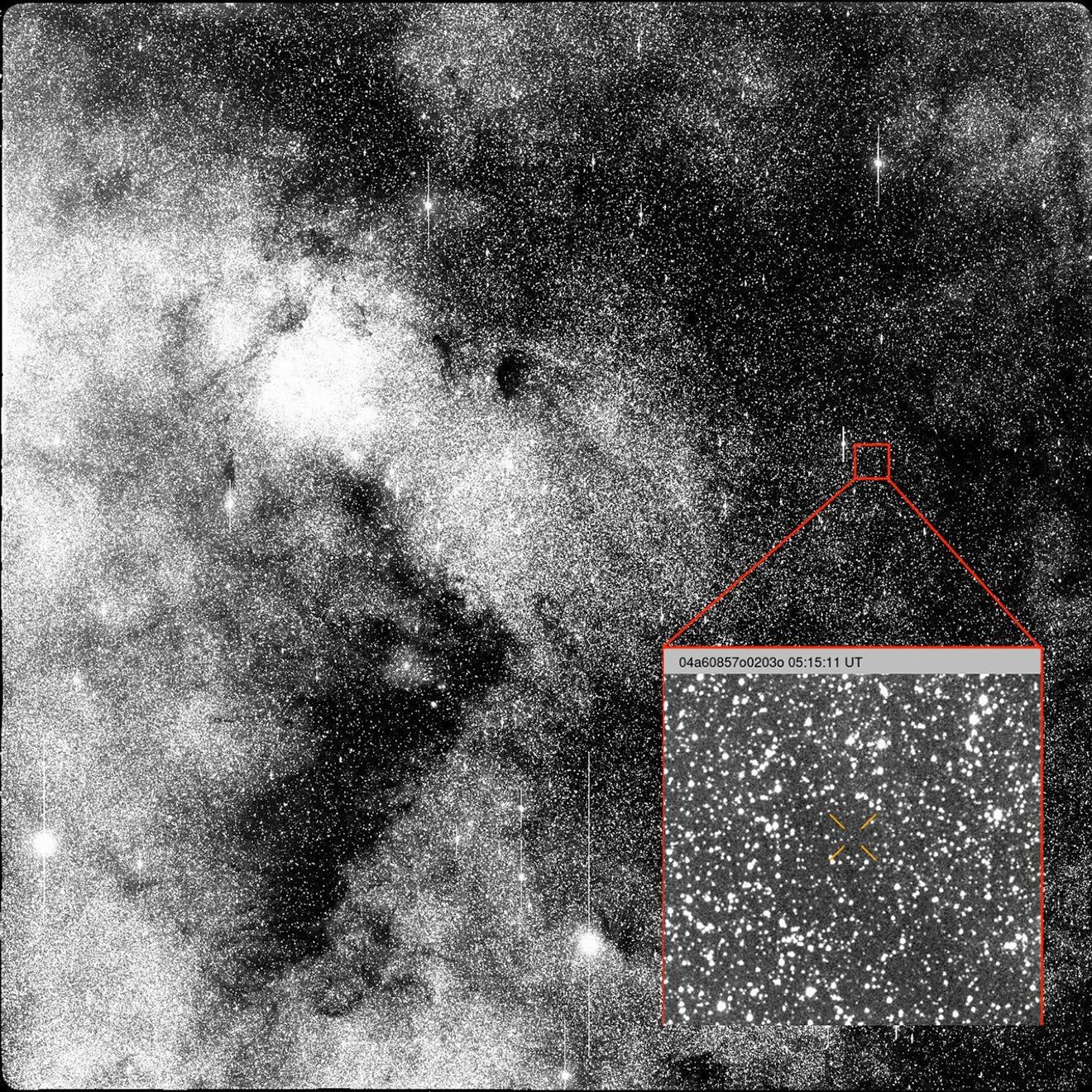
NASA's Psyche mission acquired four broadband black and
white images of the comet over the course of eight hours on September 8th
and 9th, 2025. The comet was about 33 million
miles from the spacecraft at that time. And you can see in the image the
large frame where the comet was seen at different
times. Down in the bottom left is a blow up a stack.
In addition of all of those observations, the Psyche spacecraft
is on its way to an asteroid in the main asteroid belt that's also named
Psyche. And These images were the first captured from this perspective.
Now, if you think in that lower left, you're not seeing very much. Just wait
a minute. You'll see more now. The following week in September,
the Lucy spacecraft observed the comet from the
opposite direction. So let's take a look at the Lucy image. This is
another broadband black and white image made by adding up a series of
individual exposures that were taken on September 16th.
Lucy is on its way to study asteroids that shared Jupiter's
orbit around the sun, called the Trojan asteroids. Lucy was 240 million
miles away from 3i Atlas, which is circled in the center. When its high
resolution LORRI camera caught the comet. You can
see the comet's coma, the fuzzy halo of gas and dust surrounding 3i
Atlas and its tail, a smudge extending to the right of
the comet. If you were the Lucy spacecraft looking at the comet from this
angle, the sun would be a little bit over your left shoulder. And so
the comet tail is pointing away from the sun. And as we've seen many times
before in solar system comets, for scale, this image spans
about one third the width of the full moon. As you'd see it on
the sky, of course, at the distance of the comet, that's a much, much larger
region of space than the moon. Now, this looks a little different from the
PSYCHE image. Part of that is because the cameras are different, and part
is because of the ways the PSYCHE and the Lucy teams decided to show their
images. But also it's because we're seeing the comet from different directions.
Seeing a comet's coma in different lighting geometries with the
sun coming from different directions is one of the key ways to learn about
the physical properties of the dust that's been launched off its surface.
And I want to emphasize that you do not get these views unless you
have spacecraft farther from the sun than the comet is, so that
you can see it backlit. We could not get this view from
the vantage point of the Earth. So combining the data from Lucy,
Psyche and Earth based telescopes, scientists are hoping to better understand both
the three dimensional structure of the comet and the nature of the dust.
It's a rare opportunity to compare ancient dust
from a distant solar system to that from our own.
Now let's go to the next picture from the MAVEN spacecraft
at Mars. Beginning at the beginning of October,
3i Atlas passed within 20 million miles of Mars,
which gave our Mars spacecraft an opportunity for a close up.
And earlier you saw the image that Ahmed shared from our Mars
Reconnaissance Orbiter. Maven is another Mars Orbiter that has been studying
the Martian atmosphere since 2014.
Now, this picture is not a direct picture of
the comet itself. It's a spectrum. You're seeing the
science wiggles that Sean was just talking about. This is some of
those science wiggles where the instrument, the spectrograph, the ultraviolet spectrograph
on Maven, has looked at the comet and also split
up the ultraviolet light according to color. So you're seeing
three different bands in this image. On the right, you're seeing
emission from hydrogen gas in the atmosphere of Mars.
In the middle, there's a fainter band indicating that it's coming from
hydrogen gas in interplanetary space. And on the left,
that blob is the signature of hydrogen
gas coming from Comet 3I Atlas. It's a little blob
rather than a big streak because the comet is a small object
in the sky relative to great big gigantic Mars and interstellar space.
That fills the entire field of the instrument. That definitely
tells us, first of all, that the comet is there. If there were no comet,
there would be no little blob on the left side of the image.
But it's also telling us it's one of the many ways that we're able
to discern the chemical composition of 3i atlas.
And in this particular example, it's showing us the hydrogen gas that's coming
off of the nucleus. Now,
maven's observations, combined with the earlier observations by
Swift and Webb that Sean spoke about, will help determine the water production
rate, how much water vapor is released from the comet when the
comet is warmed by the sun, which provides insight into the formation of the comet
and its journey through our galaxy. Now, the European Space
agency and NASA's Solar and Heliospheric Observatory,
or SOHO, also successfully imaged 3i Atlas
from October 15 to 16 after it had passed
Mars. And SOHO spotted the comet crossing its field of view
from approximately 222 million miles away,
or more than twice the distance of Earth from the Sun.
Comet 3I Atlas was expected to be too faint for SOHO
to see, but this result was made using detailed image processing and
overlaying, or we call it stacking, subsequent telescope images.
This image highlights the value of spacecraft and instruments
designed to look directly toward the Sun. As Nikki was
saying before, not only to study the sun, but also to have
the ability to see other objects crossing, in this case, behind the
sun from the telescope's point of view, you'll be able to see the
rest of the images on our 3i Atlas.
Go.NASA.gov and
there will be more to come. Not all of the data have been downlinked yet
through NASA's Deep Space Network and there are more observations still in
work. And also it's a long way from where we are today,
seeing the initial images to then making sure that
they are accurately calibrated and processed to do science with and
then doing the analysis, combining the data sets of understanding
them and finally producing the scientific understanding, the knowledge of
what this all means, which will be published in peer reviewed
scientific journals. The answers will come later on.
We are still at this phase very much in the state where we're figuring
out what are even the right questions to ask about interstellar objects.
This is a snapshot of where we are very early in
the scientific process. Okay, back to you, Courtney. All right, thank you
all for your opening remarks. We'll go ahead and start the question and answer portion
of this event. Just a reminder to our media on the phone bridge to press
Star one to enter the queue and ask your questions. We'll take
our first question from the phone bridge from Marcia Dunn with the Associated Press.
Yes, hi. Based on your latest observation,
what more can you tell us about the potential shape of the comet?
Can you fine tune any more on how
big or small it might be, origin,
all that sort of thing? Thank you. Thanks for that question.
There's a lot of territory to cover there, so let's see what I can do.
The size of the nucleus still has yet to be
pinned down. The best data are still from the Hubble observations
that Sean was talking about. So we're still right
now in that range of somewhere in the vicinity of
a couple of thousand feet to a couple of miles diameter.
But we'll get better on that one. The shape of the
nucleus is also difficult to pin down because generally we're not resolving
it in our observations. It's obscured by the dust and especially it's
obscured by the reflected sunlight off of the dust in the
inner part of the coma. But what observers from the ground have been able
to do is observe the brightness of the center of the comet over
time to see if there's a modulation of that brightness.
That would be an indication of rotation. And it's very difficult
to discern. So what it's looking like so far is that
there's not a big the shape of the nucleus is not very far
from being round. It doesn't seem to be a big or at least we're not
seeing signatures of a very elongated object yet.
There's a lot still to come there I think you were also
talking about origin. It would be
great, it would be fabulous if we could trace back the
incoming trajectory into the solar system and trace that back and
figure out where it came from. But things are not quite so simple.
Our galaxy, as Sean knows, is a big and complicated place.
And the sun and all the other stars in our galaxy are in orbit around
the center of the galaxy. And so 3i
Atlas has been in interstellar space for a very long time. There is circumstantial
evidence, given how fast it has come in to
our solar system, that it came from some
very old population. A solar system around
a very old star. Quite possibly, we can't say this for sure,
but the likelihood is it came from a solar system older than
our own solar system itself. Which gives me goosebumps to think about,
frankly, because that means the 3i Atlas is not just
a window into another solar system, it's a window into
the deep past. And so deep in the past that it predates
even the formation of our Earth and our sun.
All right, we'll take our next question from the phone bridge from Bill Harwood
with cbs.
Bill, if you're talking, we can't hear you.
Tell me again. This is Bill Harwood again. Can you hear me? We have you
loud and clear. Okay, thanks. Sorry about that.
You know, I'm mentioning the rumors that were, you know, kind of scurrying around about
this thing in the weeks leading up to this briefing today. I have
two questions for anybody who care to answer. One is, did any of you seriously.
Did you take seriously the. The proposition from some that
this could be an alien spacecraft? I doubt you did, but I'm asking
the question anyway. And number two, is there any evidence you see in any
of the data you have that that would fit an explanation
like that, or as far as you're concerned, as all of this data say conclusively,
that this is simply a comet that happens to be passing through the solar
system? Thanks. So I'll take that one, Bill, and thanks for the question.
We love all of the different science and all of the
different kind of hypotheses into what these things can be. You know,
when you start seeing something, you just got to point. You know,
it's natural to wonder what it is. And we actually love,
as Almit said, we love that the world wandered along with us, and that's such
a cool thing. We certainly were able because of
the. The measurements that Sean described from the astrophysics
telescopes that immediately turned on, on this object once
we found it. And even, you know, I was interested. I just learned that we'd
actually gone back and actually seen it before we even found it. So that was
super cool. I just found, just heard that from Sean. But, you know, we,
we were very quickly able to look for sort of, you know, the easiest
thing to do, I'll put it a different way, is if you, if you understand
comets pretty well and you understand asteroids pretty well, you kind of know the signatures
that you're looking for. And so you can sort of look for those quickly and
tick them off and say, yep, it really does behave like a comet.
The interesting thing that, you know, Tom, I know if I give him,
if I throw it, throw this to him in a second, he's going to geek
out about it. But the, the really cool thing about this
is the differences because it comes from somewhere else and that's why
we're so excited about it. It's only the third time that we've been able to
identify and track something coming from outside our
own solar system. We've long predicted these things occur and now,
of course, we know better how to look for them. And we now have this
amazing ATLAS array. You know, we're expecting we'll find a lot more of them,
but it was quick. We were quick to be able to say, yep, it definitely
behaves like a comet. We certainly haven't seen any, any techno signatures
or anything from it that would lead us to believe it was anything other than
a comet. But the super cool thing is not that it's exactly like
all the comets that we see in our solar system. It's the differences that
are so tantalizing for us as we, we. And you know, it gives me goosebumps
too. It's, it could be from something that existed before our own solar system.
That is so cool. It's, it's from something that predates
even our own star. Yep, it's going
to look different because it didn't come from our solar system.
And that's what makes it so magical. You want to geek out a little bit.
You were geeking out so expertly, Nikki, to begin with.
Embrace. That was, that was fabulous. But that's exactly right. I mean,
objects from things from other places, we naturally expect them to
be different from our own homegrown variety. And I like to
imagine if you, you know, if you're fortunate enough to have grown up in Hawaii
and you only drank Kona coffee, you love your Kona coffee. And then somebody
says to you, well, gee, have you tried Sumatran? You're going to say,
well, do you expect it to be different? And they'll say, why don't you try
this? And you try it and you say, wow, that's really different. And you realize,
well, I expected this to be different because it was from someplace else. It was
a different environment in Sumatra. Now, does that, does that one sip of coffee
tell you everything about the weather in Sumatra and the soil and the
people who harvest the coffee, bless them?
Of course not. But it's, but it's different and yet it's still coffee.
And that's what we have in this case. We have a commentary body.
It behaves, it resembles the homegrown comets that we
have in our solar system, and yet it's excitingly different in particular ways.
It does the same thing comets do. Comets do. It evaporates
carbon dioxide gas, it evaporates water, but it's
evaporating more carbon dioxide compared to water. So that's a very interesting
thing. Comets evaporate dust and the dust is broken down,
the minerals are broken down by the ultraviolet light of the sun.
And comets, we know comets put out nickel,
they put out iron. That's what comets do. This particular one
is putting out more nickel than iron. That's really interesting,
really remarkable and something to be studied in the future.
So we're always interested in new ideas, we're always interested
in new suggestions. And all ideas are good when they're born.
But those that stand the test of time, those that stand, stand up to testing.
Those that are supported by the evidence are the ones that survive.
All right, we'll take our next question on the phone bridge.
And that one comes from Matthew Glasser with abc.
Good afternoon. Thank you for doing this. Tom mentioned that you
know, the answers will come in time. I'm curious about what are some of the
hopes that we might discover from this comment. What might it tell us about our
planet, about our solar system, about the, the universe? Are there key things you're
looking for as you start to analyze this data? And are you excited about anything
in particular when it comes to better understanding how things are working out there?
Sure, I can take that.
Every new object we discover is a new piece
in the puzzle. What we're trying to do always is to
understand the universe. That's part of the NASA mission, is to understand the solar
system, understand the universe, understand the origin of planets, the origin of life,
and that is a huge question. And we get little
bits, little clues to parts of that puzzle and we start trying to put that
puzzle together. We have gained tremendous Amount of information from
hundreds of years of astronomical observation and from decades of in
situ spacecraft observation has revealed our planet's as actual
places, not just points in the sky that you could barely see with your own
eyes. We've learned about comets and asteroids and we're beginning to put together
a picture of how those, how all of
those planet forming minerals and planet forming ices came together to
form our planets and how our solar system changed over time.
Just one example, we get a fascinating clue from
the objects like Pluto that we've been discovering
since the 1990s. The Trans Neptunian objects,
the way they are distributed through space in the outer solar system,
show us clues to how the orbits of the major planets may have
changed over time in the early solar system. A fascinating thing and
questions that we would never have thought to ask before we knew about these trans
Neptunian objects. Now, interstellar objects, like I said before,
are new windows, and it's windows that we've never even looked at out of before.
So what we're going to find is way too early to predict. But I think
we're getting a hint of the breadth,
the wide spectrum of conditions that existed in different parts
of the galaxy in different solar systems, where the compositions,
the elemental abundances, the mineral abundances may have been very,
very different. It would be a different picture if we were seeing the first three
interstellar objects and we'd say, gee, those look exactly like our homegrown comets.
That would have been really interesting. And we would have said, well,
maybe our galaxy is a boring place because every place is the same. What we're
seeing with this is not every place is the same. That's a good thing.
Lots of places to explore and they will be different if we ever manage
to get there. Yeah, I think of these as frozen fossils
from their moments of formation, including the things in and now
from beyond our solar system, or in some cases, we point our telescopes at
other debris disks, which is just, you know, a whole system full
of these small bodies. And so now what this will let us do is tell
that story in a broader context between the detailed and
large library of data we have on those origins
of our own solar system and how volatiles were delivered to make life possible here
on Earth, combined with that big picture of other systems,
of the dust spread throughout those other solar systems. And now with this
visitor that got frozen in time from somewhere beyond our
solar system, and that small picture of what that was like when that formed.
And the fact that, I mean, I love the sort of Thought of it as
that frozen fossil, almost frozen time capsule. We're kind of
privileged. I mean, it's come into our solar system, our sun.
We know, we think it hasn't seen a star for a long time.
So it's actually warming up and giving us more information.
It isn't just about a frozen object coming through and us sort
of saying, oh, look, there's a frozen object moving through. But as it's, it's almost
waking up and showing us its composition.
And that's allowing us to be able to do this great science. If it had
just remained frozen all the time, we wouldn't know much about it. But it is
the sort of its rendezvous with our star that is allowing us to
really do this amazing science. And that to me is it makes me feel
almost privileged to actually be able to unlock the secrets as
this cometary object is coming around
and rendezvousing and interacting with our solar
system. All right, let's head over to social media. Nina on
X asks, will it hit any planets in our solar system?
No, it will not. And you know, I think if
you, obviously we're not going to run it again, but please, you know, go,
go online, take a look at, at go to NASA.gov/3i-atlas
and take a look at the trajectory.
I kind of talk through it briefly. Tom, talk through it and
you can sort of see where those planets are. And remember this, even though
it's exciting and it's coming through space is huge, as both Sean
and Tom talked about. And so the probability of it actually hitting anything is
super, super small. You have to have all these things aligned to actually be able
to do it. But certainly the objects in our solar system will
be just fine. And we have another question from social media
from Astronomayam. They ask what makes Comet 3i
Atlas so different and intriguing compared to the other interstellar comets?
Tom, you want to it now the other, other other interstellar objects,
we say interstellar objects because not all of them were comets. So the first one
was discovered in 2017. That was one eye Oumuamua
that behaved very much like an asteroid.
Again, a little bit like 3i Atlas, a very interesting
asteroid in some ways different from the asteroids we're accustomed to seeing in our solar
system. For one thing, it seemed to be very, very elongated.
And while it was inactive, it seemed to be an inert,
mostly rocky object. It did show indirect
indications that it was evaporating gases in some way.
It wasn't around long enough for us to get really, really comprehensive
long duration observations and understand exactly
what it was doing. It was the very first one. We saw it for a
short time when it was on its way out, in fact, and so we didn't
get a great view of that. The second object,
two I Borisov discovered in 2019,
2019, behaved. It was a comet.
It was definitely a comet. It behaved in a lot of ways like our homegrown
solar system comets. In some, in many ways, like 3i
Atlas, its properties were more in
line with what we're used to seeing. And the comet
observers regarded it as very much akin to our solar system
comets, although in some ways a little bit at the edge of what
we're used to seeing. 3i Atlas is in a lot of ways like
2i Borisov, but a bit more out there
in terms of things like the carbon dioxide to water ratio.
All right, Svetlana on LinkedIn asks, will the observational data from
this campaign be available for open analysis?
Absolutely. Every piece of NASA data we
are delighted to share. We, we've had open data
policy at NASA for a long time. We, we make a big effort not just
to release the data, but also to make sure it's usable so you can get
the tools and things to actually analyze the data as well. And we invite
everybody to, to look at this comment with us if
you're able to take your own images through, like, citizen science programs.
We love that, too. We love everybody to be sharing in
the joy of NASA science as we take every opportunity to
take advantage of these incredible visitors to our solar system. And that citizen
science campaign that includes work that citizens help us
do to identify small bodies in our solar system. And so if you really want
to get engaged beyond just looking at the data, you can help us generate new
data and find other objects for us to study. Yep. The big, big one Solar
soho. Big, big comet finder, big comet tracker.
So many of those comets discovered by our citizen scientists. So keep
those, keep those observations coming. All right, we'll head back over
to the phone bridge. Our next question comes from Ken Chang with the New York
Times. Hi. Thank you.
This is for Tom and Nikki. One of
the measurements made so far. What is uniquely different about this
comment, other than the trajectory, of course, and two since
perihelion, it looks like it's, there are multiple jets. I was wondering if you could
talk about that and the speculation that it might have exploded. Thank you.
Go ahead. Yeah, thanks, Ken.
So some of the differences I already mentioned is the
ratio of the carbon dioxide to water ratio, the nickel to iron ratio.
Also there were ground based observations noting that the
polarization of the light reflected off the dust was
also unusual. So that's telling us some interesting things about the dust. There are
other indications that the physical properties of this dust,
maybe the grain size distribution, might be different
from the sorts of things that were used to. The appearance
of a sunward tail early on in the trajectory
was part of that, an indication that the dust was being pushed off the comet
on the sunward side and that it took a while for the solar radiation
pressure to push it back the other way. That's been seen before in other comets,
but not very often.
And I'm sorry Ken, what was the second part of the question?
Did it explode? The jets? Yeah, yeah, yeah, the jets.
Right. So seeing activity,
see more activity in the inner coma around the
nucleus right around the time of perihelion when it's being warmed most
intensely, is something that happens frequently. That's something the
comet observers are going to be very, very excited about. It does take some time
to figure out because it's time for the actual event that happens
on the surface to propagate out to a distance where you can see it with
a telescope. But people are going to be mapping what jets
there are. It doesn't necessarily mean there was an explosion.
Jets can also just mean there are particularly active areas
on the surface of the comet where more volatile
stuff is evaporating in that one spot than elsewhere and
jetting out. We saw this a decade ago with
the ESA Rosetta mission at
Comet 67P. It got up close and personal with
the nucleus and saw frequently that there were jets coming out from specific
places on the nucleus of the comet. So that could very
well be what's going on here. Can't tell for sure, but that's the sort of
thing we've seen before. The other thing I just want to say that we're expecting
to see as more stuff gets thrown off this combat
in these jets is at those warmer temperatures, additional things
can bake off of additional gases can bake off. And so we do expect the
composition to, of the, of the coma to potentially change or those jets to change
over time. And looking at the details of what other molecules we detect,
beyond the carbon dioxide and water we mentioned, is also going to be interesting especially
for that sort of like, like what was this, what was the area in this,
what was this stuff made of in the area it was made like long,
long time ago. Our next question is from David Chandler
with Sky and Telescope.
Yes, a couple of things.
Have you Any of these observations showing
you anything about any non gravitational accelerations
at this point. And also, can you say a little bit about coming attractions?
What observations are in the pipeline that have been made but not
released yet? I think the MRO high rise observations,
has that been released yet? And what else is there that's
either in the can and waiting to come out or observations
that will be made over the coming weeks as the object comes closer
to Earth? I can answer some of that about the non
gravitational accelerations. This is something that we look
very closely at for every comet because that's always something
that happens. And just to back up, to explain what the question is,
is that as comets evaporate, they are
blowing off gas, they are blowing off dust and everything. Every time
something gets pushed off the comet that acts like a little rocket
engine at that moment and pushes in the other. And so it's very, very common
to see comets have subtle changes in their
orbits as a result of these little rocket forces,
just called non gravitational accelerations. So this is being monitored very closely.
I spoke to our orbit determination team at the Jet Propulsion Laboratory
earlier this week and what they said is that this is being monitored.
There are some changes to the orbit,
but the uncertainties are still
fairly large. It's difficult because we can't see the nucleus directly.
It's difficult to get a very, very precise track on exactly where
it's going. But so far the non gravitational accelerations have been
very much on par with the sort that we see in solar. System comets in
terms of future observations. This is a situation where,
because this is only the third time we've had an opportunity to look at an
object like this, everyone that is in control of a telescope wants
to look at it because it's a fascinating and rare opportunity.
I know that our colleagues from the Keck Observatory have looked at it.
I believe that we're going to look at it again with JWST in December.
We have some other ground based facilities that are giving us additional compositional information
as those additional molecules bake off of 3i atlas.
Those are the things I'm aware of. There's probably a lot more that I'm not
because like I said, like every astronomer wants to get data on this thing because
it's such a rare opportunity. Yeah, and the, and the high rise image that you
asked about specifically, Ahmed kind of rolled that out at
the beginning. So please, please take a look at that image.
I think, you know, Sean is not bragging a lot on what these astrophysics
telescope. I don't why? But, you know, because we are able to look at it
in infrared with the James Webb Space Telescope. That will be the last time we
can see the comet. So as it is. As it is exiting the solar system
and getting further and further away, the James Webb Space Telescope will
actually be able to track it longer than anyone else, partly because it's of its
ability to kind of look long and deep rather
than sort of across and wide. And the fact that it looks in the ultraviolet,
so, sorry, in the infrared, so it can kind of see the dark objects.
And so I'm really excited about just sort of, you know, tracking it till the
very end. Also noted we're downlinking data from
missions. I mentioned Parker Solar Probe, because I just heard before we
came on that we've got some data and we'd seen the comet. I haven't had
time to look at the data yet, but all of those things are coming up
as we are getting, getting more and more data coming down to us from those
missions. And then as both Sean and Tom talked about just,
just really making sure we are sharpening up those images and, and really, you know,
making sure they're calibrated. Right now we're putting out almost the raw images. We're putting
out things quickly so everyone can see them, but we'll take some time and do
some, you know, real sort of deep looking into those and do some
more of the spectroscopy. Tom showed a really great example of kind of looking
through the atmosphere of Mars, taking a. Taking.
You take out that hydrogen, take out the hydrogen from our solar system,
and then let us look at the hydrogen that's coming from the comets. We'll be
doing a lot more of that as we move, move on to do great things
with NASA science. All right, that's a great lead. In to our next question on
social media, Elijah on X asks what kind of processing were the images
subjected to and why did they need it?
The, the. The images that were released received the
sort of standard processing that we do between the raw data that comes down
into a telescope that, as Nikki said, you know, we need
to make sure for scientific accuracy that they're calibrated against the other
observations and we account for anything that the telescope is doing
in that moment. And so that there's. It would be our standard set of calibrations
and normalizations for a object of this type,
which is to say a comet. I can add a little bit more to that.
Theas Nikki said our desire was to get these images out
to the public as quickly as possible. And so there are some
image artifacts in there that you'll see. And I can specifically, I can speak
to the Lucy image that you saw previously. If you look
at the comet, you'll see some blobs around the comet. Little blobs,
faint blobs around the comet are not real. It came from the fact that in
order to get this particular view, it was necessary. Since this
backlit view, the team had to turn the spacecraft to
face more toward the sun than it generally does.
And so that means some part of the spacecraft were in the sun
and some of that bright, you know, the sunlight reflected off parts of the spacecraft
got into the camera and that resulted in those little blobs.
So that's an example of processing that has yet to be done to
figure out exactly what that scattered light contribution was and
remove that from the image so that what we show in the image
is entirely what was there in the sky and not
something just made by sun glints off the spacecraft hardware.
Yeah, and sometimes I think you showed the SOHO image where we actually stacked
a couple of images, because a single image, you wouldn't be able to see
it. It would be too faint. But if we stack a couple of images
together, then you can actually start to really make out what that comet looks
like. Okay, next, Gail on Facebook asks,
how can an object like 3i atlas come from so far, moving as
fast as it is and not hit anything?
Orbital dynamics and space is really,
really huge. And so, you know, it's, it is
amazing to think about just how big the,
even our solar system. And so to give you the Voyager
spacecraft, Voyager 1 is now one light day away
from Earth, which means when we send a command or we send,
you know, a photon from Earth, it takes a full day for
that photon to arrive at Voyager. And Voyager is
only just outside kind of what we think of as the edge of our solar
system. And so space is vast. Yes,
yes, this thing is moving quickly. And yes, it came from outside our solar
system. But you know, it really, the probability of it actually hitting something is
so small, everything has to align. It's also not
quite in the ecliptic plane. It's not quite in like the, our normal.
If you think about sort of looking side on at our solar system with the
sun and then you put the planets kind of in a row. Normally everything sort
of orbits in this plane. This is slightly tilt tipped,
not unusual because it's not gravitationally bound to our sun,
but it's slightly tipped. That makes the probability of hitting it almost Even
greater if I can play. With a scale model solar system.
If you make a scale model solar system where the sun and the Earth are
one foot apart, that's about one foot. The sun is a P the
Earth, you need a magnifying glass to see. It's so small,
the entire solar system will just barely fit in your house if you
squeeze a little bit. And the next nearest star is over 50 miles
away. So they call it space for a reason.
Most of it is space. Okay,
we'll head back to our phone bridge. Our next question is from Brandon
Spector with Live Science.
Hi, I wanted to ask about the age of laconic. You mentioned
there's circumstantial evidence that it's much older than our solar system.
But how can we constrain that age a little more?
And what will that tell us if it is indeed much, much older than the
solar system? I can start that, but I'm going to pass it
to Sean to talk about ages in the galaxy. Okay, so cutting
to the end, the bottom line is going to be it's probably going to be
really hard to get a more precise figure from one object. I think we what
we're looking at in the future as we
discover more of these, when we get to the point where we have maybe a
few dozen of them and look at the distribution properties, we may be able to
get a better handle on what the distribution of ages is.
So what's going on here is that it
takes the sun 240 million years to orbit around
the center of the galaxy, and we're doing that with a neighborhood of,
of stars. So we're all going around the center of the galaxy.
The relative motions between stars in our solar
neighborhood is sort of 10 ish 15. And sorry, I have
all these numbers in my head in metric because that's the way I learned them.
But 10 or 15ish kilometers per second. So what is that? That's about
25,000 miles an hour, I think.
And 3i Atlas is coming through at a speed of 60 something kilometers
per second. So that's three times faster than the average
of our local neighborhoods, which is telling us
that it's coming from a different population from what
we have generally around us Now. Sean will be able to clarify the age dispersion
relation in our galaxy, which tells us, which has been discovered
over the last century studying stars in the galaxy,
that the relative speeds of stars is an
indicator of age. Stars that formed older in our
galaxy over time increase their random motions for reasons
that Sean will explain. And so that's
the circumstantial evidence that makes us think that 3i Atlas
came from a solar system that had
larger motions relative to our solar neighborhood and is
older. But it is a circumstantial and probabilistic argument. So I'm just going
to take this opportunity to brag about our telescopes and the James Webb Space Telescope
in particular. This blows my mind. We have data from
galaxies closer to the origin of the universe than
we have data from rocks closer to the origin of Earth. Right. In other words,
like, if you pick up the oldest rock that we have from Earth, it is
further away from the origin of Earth in terms of, of hundreds of millions of
years than the amount of time there was between the origin of the
universe and the earliest galaxies that JWST has now observed. And that's part of the
story of how well we understand not just the history of our home planet,
but the history of the entire universe that it's a part of. And now this
is just another part of that story of the local neighborhood that our solar system
is a part of. All right, our last question
for today comes from X and asks, if we can see grains
of sand on Mars, how is the clearest photo we can see
for three I Atlas what we've seen?
So because we're closer to the grains of sands on Mars. Right.
And so, like, this is like, JWST can only get,
like, these single pixel blobs of the faintest galaxies,
the furthest away galaxies in our universe. And because three Atlases in our solar
system, we can get the images and the compositional information with jwst, as it got
closer to some of our, the planetary spacecraft Tom was talking about,
they can't even see these galaxies. But because 3i Atlas was closer to them than
they were to JW, they got really good images of the object as it
passed by. Right. As you said, we can image individual grains on Mars
because we have spacecraft standing on Mars. But even our closest
spacecraft to 3i Atlas were still 19 million miles away.
And it's going too fast for us to send something there to, like, you know,
intercept and get that close to it. So that's just not that we just don't
have. If we, if we could, we would like, we would be there
up close and getting those grains. All right, well, that's all the time we
have for today. Thank you so much for joining us. Be sure to follow
along with NASA as we continue to observe 3i Atlas.
Find new images, detailed information and resources by
visiting go NASA and
by following NASA Solar System on social media. Thanks for joining.
Sam.